
Greek Collegiate Programming Contest
The International Collegiate Programming Contest (ICPC) is the leading global programming competition among the world’s universities! The contest originates in 1970’s UPE Computer Science Honor Society and has since spread globally. The competition aims to foster ambition, novel ideation and problem-solving aptitude in the field of computing and simultaneously provide opportunities for talented students around the world.
A Greek sub-contest of ICPC, GRCPC, was held for the first time in 2023! It is organized by the Algoforum team, based in the University of Patras. The event is held in 6 venues across the Greece simultaneously and online for the rest of Greece. At the same time, with collaboration with UCLan, for first time in 2025, there will be one site in Cyprus for all Cypriot teams to meet there. The best teams from each University are supported to represent their Universities in the Southeastern European regional phase, in order to claim a shot at the World finals!
Rules of the game!
In GRCPC we try to strictly follow the rules of the World Finals with small exceptions.
In summation:
In more detail, teams of three students from the same University can participate in the contest and diversity in the subject of studies is suggested (e.g. 1 Computer Scientist, 1 Mathematician and 1 Engineering student). Each team is assigned one computer without access to the internet, but you are allowed to bring 30 pages of notes of whatever you like (commonly used algorithms or language specific problems are suggested; you can find notes previously used in ICPC competitions online). You will face around 8-14 algorithmic real-world problems and will be called to solve as many as possible in the 5 hour timeframe. The solutions will be submitted through our platform.
Don’t worry if it seems too hard; you all play by the same rules!
How Teams Qualify for SEERC
How teams are found: The best teams from each University represent their Universities in the Southeastern Europe regional phase.
At the National phase: Teams compete mostly with teams from their own University. However, there is a second ranking system that determines how many teams each University can send to the next phase based on their National level performance.
Team promotion to SEERC: Each University can send at least 1 and at most 3 teams to SEERC, depending on the second ranking mentioned above.
This qualification system balances fairness by ensuring all universities have representation while rewarding universities that demonstrate stronger competitive programming capabilities with additional team slots.

Additional rules for online competitors
- Contestants are allowed to participate from any location of their choice. Team members do not have to gather at the same location.
- Contestants can use the Internet during the contest, however:
They are not allowed to publish or post any information on the internet during the contest. They can only communicate with their team members, organizers and jury during the contest. Contestants must only use information that was published before the start of the contest. Therefore usage of LLM services, like ChatGPT or Bing, is explicitly banned. - Contestants are allowed to use preexisting code found on their computers or on the Internet. Any code copied off the internet must be explicitly marked with a comment containing a URL to the original source.
- There are no restrictions on software use during the contest.
What Happens at SEERC
Teams compete in a 5-hour programming contest where they solve algorithmic problems. The top-performing teams advance to higher levels:
- Top 13 teams qualify for the ICPC Europe Championship (EUC)
Resources to getting started:
Test your skills with the GRCPC 2023-2025 problems!
Or check out some past problems from the World Finals!
(World finals problems are a bit harder than regionals’ 😉 )
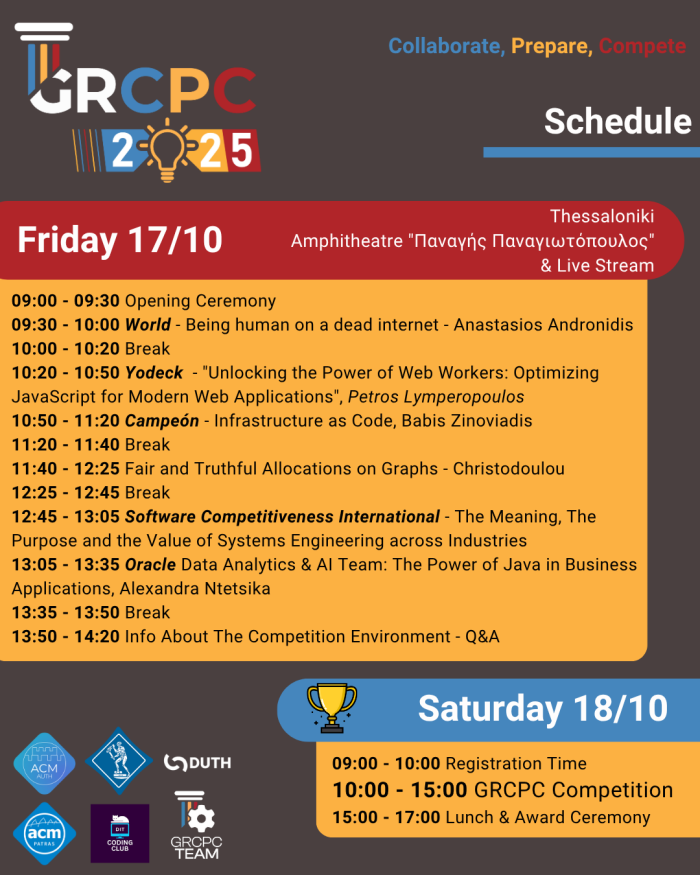
Speeches and Competition Program for GRCPC 2025
Here is where you can compete!
Students studying in Thessaloniki, Athens, Patras, Ioannina, Kavala or Chania should compete in the venues below.
For Cypriot students all teams should compete in Larnaca at the venue below.
Students studying in Universities in the rest of Greece will compete online.

University of Patras
Check back to be informed of the specific competition hall.

Aristotle University of Thessaloniki
Check back to be informed of the specific competition hall.

National Technical University of Athens
Check back to be informed of the specific competition hall.

University of Ioannina
Check back to be informed of the specific competition hall.

Democritus University of Thrace
Check back to be informed of the specific competition hall.

GRCPC 2025 Environment Information
OS: Ubuntu (22.04.05 LTS)
Desktop Environment: Xfce 4.16
Programming Languages:
– Java 11.0.28,
– C gcc 11.4.8 (Standard C17),
– C++ (cpp) g++ 11.4.0 (Standard C++17),
– Kotlin 2.2.0
– PyPy 7.3.9 + gcc 11.3.0
– Python 3.10.12
Editors:
– VIM
– Nano
– gedit
– geany
IDEs:
– Eclipse 2025-09 (4.37.0 M1) configured with: Java Development Tooling (JDT) version 3.20.300.v20250708-0825 using Java 21.0.7
– Apache Netbeas IDE 18
– Intellij IDEA Community 2025.2.1
– PyCharm IDEA Community 2025.2.1.1
– Code::Blocks 20.03,
– VS Code 1.104.0 – With Extensions[1]
Documentation:
Java – https://docs.oracle.com/en/java/javase/11/docs/api/
Python – https://docs.python.org/release/3.10.12/
C GNU C Library Reference Manual, for version 2.42
C++ – https://cplusplus.com/files/tutorial.pdf & https://stl.boost.org/
Kotlin – https://kotlinlang.org/docs/kotlin-reference.pdf
[1] akamud.vscode-theme-onedark@2.3.0 akamud.vscode-theme-onelight@2.3.0 jprestidge.theme-material-theme@1.0.1 kevinkrose.vsc-python-indent@1.21.0 tlfvs.vscode-emacs-friendly@0.9.0 ms-python.debugpy@2025.10.0 ms-python.python@2025.14.0 ms-python.vscode-pylance@2025.7.1 ms-python.vscode-python-environment-manager@1.6.0 ms-vscode.cmake-tools@1.21.36 ms-vscode.cpptools@1.16.5 ms-vscode.cpptools-extension-pack@1.3.1 ms-vscode.cpptools-themes@2.0.0 redhat.java@1.45.0 tgreen7.one-monokai-dark@1.0.6 visualstudioexptteam.intellicode-api-usage-examples@0.2.9 visualstudioexptteam.vscodeintellicode@1.3.2 vscjava.vscode-gradle@3.17.0 vscjava.vscode-java-debug@0.58.2 vscjava.vscode-java-dependency@0.24.1 vscjava.vscode-java-pack@0.29.2 vscjava.vscode-java-test@0.43.1 vscjava.vscode-maven@0.44.0 vscodevim.vim@1.30.1
Road to the World Finals!

Local Contest
The first part of the competition, Greek students across the country compete to claim their chance to challenge the best teams in the Southeastern European region… and have fun!
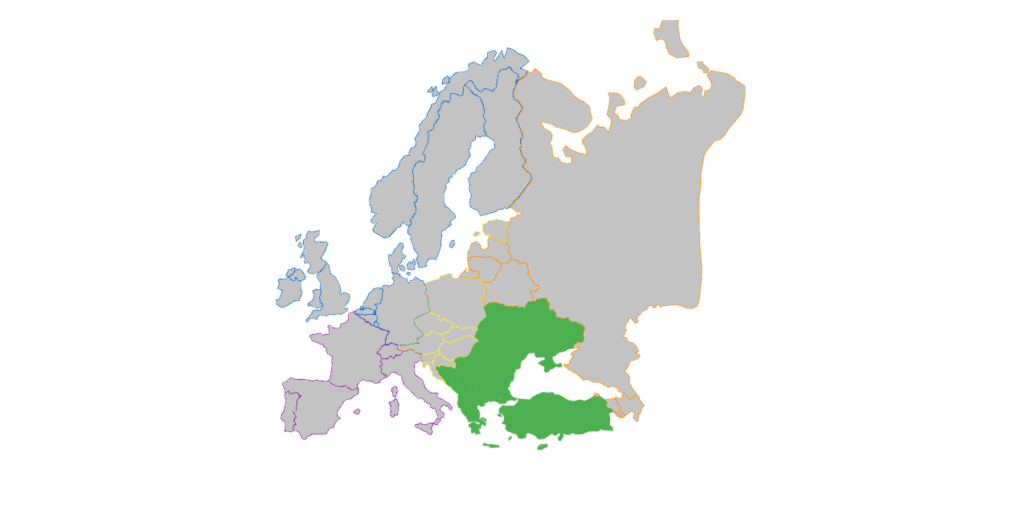
The second stage of the contest is the Southeastern European Regional. Local contest winners are pit against each other to determine the european regional participants. The 2023 Southeastern European contest was held in Romania.
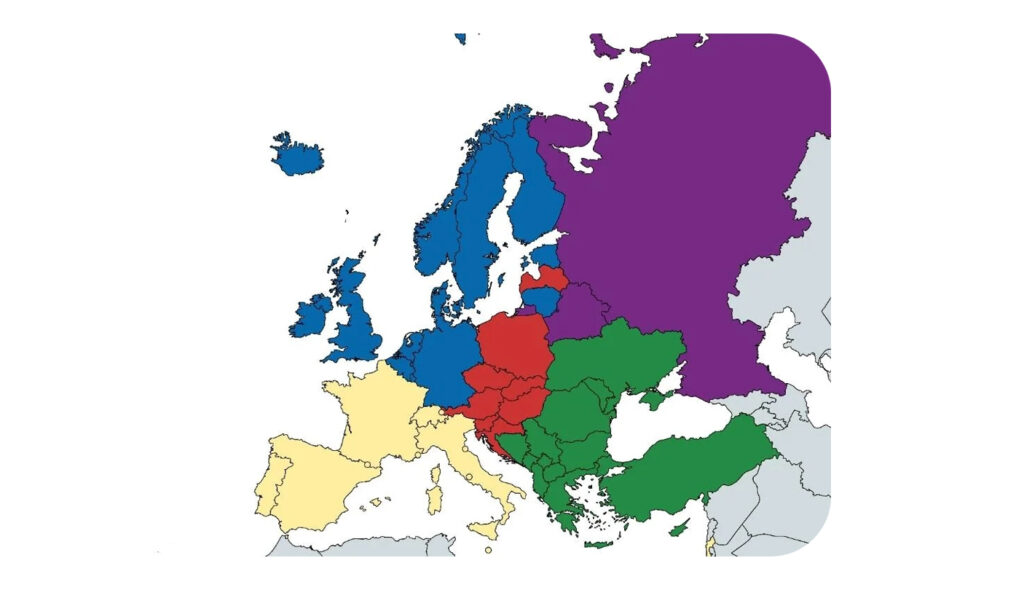
The third stage of the competition is the European Championship, where winners from regional contests compete to secure their spots in the finals. The 2024 European Contest took place in Prague.

The final stop! A handful of the best teams from each regional contest gets a ticket for the final event. Students from around the globe gather to compete for the title of ICPC World Champions! Are you up for the task?
Steps to Victory!
Problem Analysis
Without knowing the problem, you can’t move forward. Have a clear understanding of the problem to reach a solution.
Design your Algorithm
Consider several algorithms for solving the problem. Keep redesigning your solution until you succeed. Some times simple is better (KISS).
Implement your Algorithm
Develop an action plan to implement and execute the solution process. Divide your team duties and work together for the best outcome.
Evaluate the Result
Review and evaluate the results to verify that your implementation is fit to solve the problem.